
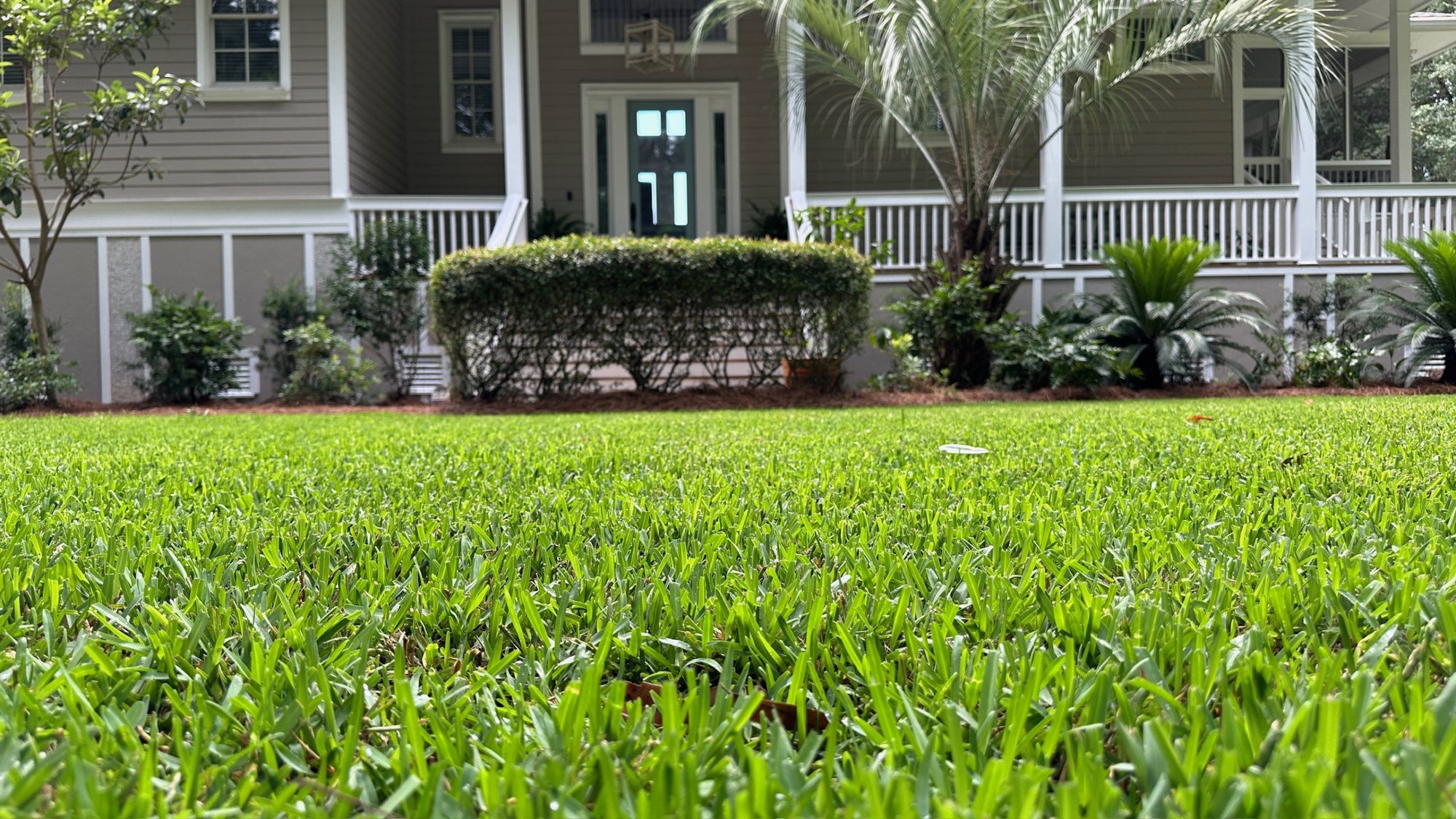
Cobalt Hybrid St. Augustine is one of the most heat-tolerant sod varieties for the Gulf Coast, but even the toughest grass needs the right start. Summer establishment brings real advantages, like fast root development and quick fill-in. It also means working against high temperatures, intense sun, and thirstier soil. If you can follow this guide and get the first few weeks right, you’ll set your Cobalt Hybrid St. Augustine lawn up for years of dense, dark green coverage.
Whether you’re laying sod at a new build in Summerdale or refreshing a tired coastal lawn in Pensacola, this guide covers it. Here’s exactly what your Cobalt Hybrid St. Augustine needs to root in strong this summer.
Why Cobalt Hybrid St Augustine Handles the Heat So Well
Texas A&M AgriLife developed Cobalt Hybrid St. Augustine through nearly two decades of research, and it shows in how the grass performs. It carries excellent drought resistance, strong shade tolerance, and good disease resistance. All of that comes wrapped into a grass with a distinctive dark green color and wide leaf blade. In independent turfgrass trials, Cobalt outperformed several long-standing St. Augustine varieties in overall quality, drought recovery, and spring green-up.
That resilience matters most in the first month after installation. A grass bred for drought tolerance still needs consistent water while its roots establish, but once rooted in it recovers from summer stress far more reliably than older varieties.

Step 1: Prep the Soil Before Your Cobalt Hybrid St Augustine Sod Arrives
Good establishment starts before the sod ever touches the ground. Clear the area of old grass, weeds, and debris, then till the top few inches of soil to loosen compaction. Grade the yard so that water drains away from your foundation rather than pooling in low spots.
A quick soil test from SoilKit is worth the effort here. Gulf Coast soil tends to run sandy near the water and clay-heavy further inland. Knowing your starting point helps you amend correctly. Adding a thin layer of topsoil or compost gives new Cobalt Hybrid St. Augustine roots something rich to grow into.
Step 2: Lay Sod Quickly and Water Immediately
Summer heat is unforgiving on sod that sits around waiting to be installed. Once your pallets arrive, plan to lay them within hours, not days. Stagger the seams like brickwork and press each piece firmly against its neighbor. Avoid leaving gaps where the edges can dry out.
The moment a section is down, water it. This is the single most important step in the entire process. Freshly cut sod loses moisture fast in Gulf Coast heat. Roots that dry out before they anchor will not recover.
Step 3: Build a Watering Schedule That Matches the Heat
For the first ten to fourteen days, keep the sod consistently moist rather than soggy. In peak summer, that usually means watering once or twice daily. Keep the top few inches of soil damp without creating standing water. Early-morning watering is ideal, since it reduces evaporation. It also gives the grass moisture before the hottest part of the day sets in.
Once roots take hold, typically after about two weeks, start easing back the frequency. Increase the depth of each watering session instead. This trains the roots to grow downward in search of moisture. That’s exactly the behavior that gives Cobalt Hybrid St. Augustine its long-term drought resistance. By week four, most lawns can shift to a normal schedule. That means two to three deep waterings per week, adjusted for rainfall.
Step 4: Hold Off on Mowing and Fertilizing Cobalt Hybrid St Augustine Too Soon
New sod needs time before it can handle regular lawn maintenance. Wait until the grass has rooted firmly, usually two to three weeks, before the first mow. Test this by gently tugging on a corner of the sod. If it resists and stays put, it is ready.
Keep your mower blade set high for the first several cuts. Cutting too short stresses new roots and slows establishment. Hold off on fertilizer for at least the first thirty days as well, since young roots can be sensitive to fertilizer burn before they are fully developed. Once established, a balanced feeding program supports the thick, uniform growth this variety is known for.

Step 5: Watch for Heat and Foot Traffic Stress
Even a heat-tolerant grass like Cobalt benefits from a little protection while it settles in. Keep foot traffic, pets, and equipment off the lawn for the first few weeks so the root system can develop without interruption. If you notice a section turning slightly gray or blue-green, that is often an early sign of drought stress, and it is worth adding a bit of extra water to that spot before it progresses further.
Shaded areas of the yard tend to establish a little more slowly than full-sun sections, but Cobalt’s above-average shade tolerance means those spots should still fill in reliably with a bit more patience.
Grab Cobalt Hybrid St Augustine in Summerdale, AL
Cobalt Hybrid St. Augustine is one of the sod varieties we stock consistently across our Gulf Coast locations. Wherever you are along the coast, fresh-cut Cobalt and knowledgeable help are close by. We’re also excited to welcome our newest location in Summerdale, AL. It gives homeowners and landscaping professionals in that area another convenient spot to pick up Cobalt Hybrid St. Augustine. You’ll also find soil amendments and delivery options that make summer installation easier from start to finish.
No matter which Woerner location you visit, from our Gulf Coast farms to our Birmingham and Denver operations, our team can help you plan the right approach for your specific soil, sun exposure, and timeline.
Summer is one of the best windows to establish Cobalt Hybrid St Augustine, as long as you have the right sod, the right soil prep, and a watering plan built for the heat. If you have questions about your specific yard, or you would like to talk through delivery and installation timing, reach out to our team. We are happy to help you plan a lawn that holds up to everything a Gulf Coast summer can bring.
